THE 7-DAY FAMILY SCREEN RESET

End Screen Battles in 7 Days — Without Taking a Single Device Away

Word-for-word scripts, 50+ activities, and a day-by-day plan to reconnect as a family. By Lawrence Martin.
See How the 7-Day System WorksTakes 2 minutes to read · results by Day 4
🎁 Today’s copies include the illustrated “50 Screen-Free Activities” ebook — free.
Ages 3–16 No cold turkey Results by Day 4 86% of parents call this their #1 priority (Pew, 2025) Pay with PayPal · Apple Pay · Google Pay · Card
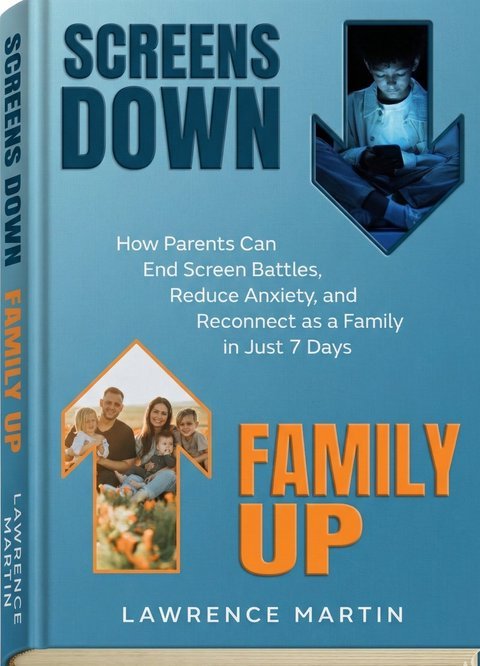
Screens Down, Family Up — book

Half of U.S. teenagers spend 4+ hours a day on screens. Those teens report 27.1% anxiety and 25.9% depression symptoms — versus just 12.3% and 9.5% for teens with less screen time.

Meanwhile, 81% of kids under 13 already have their own device, and 59% started using screens by age 3.

Sources: CDC National Health Interview Survey, 2021–2023 · Lurie Children’s Hospital, 2025

The research is clear

These aren’t opinions. They’re findings from the CDC, leading hospitals, and international studies.

27.1%
of teens with 4+ hrs daily screen time report anxiety symptoms — vs. 12.3% for those with less
CDC, 2021–2023
21 hrs
of weekly screen time for kids — parents say 9 is right. That 12-hour gap is a full waking Saturday your family loses every week.
Lurie Children’s Hospital, 2025
81%
of kids under 13 have their own device — most since age 3. Which is why "just take it away" stopped being an option years ago. The habit needs replacing, not confiscating.
Lurie Children’s Hospital, 2025
3.5 hrs
of daily screen time at ages 5–8 — and it compounds: today's 3.5 hours is the training run for the teen's 7. The earlier the reset, the cheaper it is.
Common Sense Media, 2025
58%
of 4-year-olds own a tablet — before they start school. Someone will teach your kid their screen habits: you, or the app designed to maximize their hours.
Common Sense Media, 2025
85%
of kids ages 5–12 exceed recommended screen-time guidelines
Australian Institute of Family Studies

Does this feel familiar?

Dinner is quiet — not peaceful quiet, but the kind where everyone is scrolling.

Homework takes longer. Teachers mention focus issues. Bedtime is a nightly negotiation.

You’re not failing. You’re parenting in a world designed to steal attention. You just need a system.

What changes by Day 7

Not theory — the specific things the 7-day system is built to change, one day at a time.

For your kids
  • They fall asleep faster — because the tablet isn't in the bed anymore.
  • Homework gets done first, without the fight — and the focus follows them off the screen and into schoolwork.
  • "I'm bored" stops being an emergency — they relearn how to entertain themselves.
  • They play with each other again — the fort gets built, the backyard Olympics get scored, the siblings rediscover each other.
For your family
  • Dinner sounds like a family again — conversation, not four glowing screens.
  • You and your partner run the same playbook — no more good cop, bad cop.
  • You say it once, calmly — the yelling ends, and so does the guilt that follows it.
  • A signed agreement on the fridge — and a plan that survives week two, the holidays, and grandma's house.

Inside the 7-Day Family Screen Reset

Day-by-day action plan
Clear, simple steps for each day of the 7-day plan. No guesswork.
12 conversation scripts
Exactly what to say for bedtime battles, car ride demands, and the “all my friends” guilt trip.
50+ screen-free activities
Age-appropriate ideas for toddlers to teens. Indoor and outdoor. Zero prep.
Printable templates
Family agreements, weekly planners, and tracking sheets your kids actually sign.

What parents are saying

★★★★★
“By Day 4, my kids stopped asking for their tablets. We actually talk at dinner now.”
— Sarah M., mother of 3
★★★★★
“Finally, a book that doesn’t make me feel guilty. Practical and realistic.”
— David R., father of 2
★★★★★
“The conversation scripts alone were worth it. I knew exactly what to say.”
— Jennifer K., mother of 1
Lawrence Martin

About the author

Lawrence Martin never planned to write a parenting book. He was just a dad trying to figure out why dinner had become so quiet — not peaceful quiet, but the eerie silence of four people scrolling on four different devices.

The breaking point came on a family vacation. Standing at the Grand Canyon, he watched his kids glance at one of nature’s greatest wonders, snap a photo, and immediately return to their phones. That moment sparked a journey that would transform his family — and help thousands of others.

After months of trial and error, Lawrence developed a 7-day system that actually worked for his real, imperfect, busy family. No extreme measures. No guilt trips. Just practical strategies that fit into modern life.

Today, Lawrence writes about intentional parenting, family connection, and finding balance in a digital world. His approach is refreshingly honest: he’s not anti-technology (he loves a good Netflix binge as much as anyone), but he believes families deserve more than parallel scrolling.

Lawrence lives with his wife, two children, and a dog who is the only family member completely uninterested in screens. His kids still ask for more screen time. He still says no. Some things never change — but the conversations around the dinner table? Those are better than ever.

— Lawrence Martin

Quick questions

What ages does this work for?
The system and activities cover ages 3–16, with specific ideas sorted by age group.
Do I have to ban all screens?
No. This isn’t about elimination — it’s about balance. The system helps you set boundaries without fights.
How quickly will I see results?
Most families notice a shift by Day 3–4. By Day 7, the new routine feels natural.
Will this work on a teenager who rolls their eyes at everything?
Yes — the scripts assume resistance. The system covers ages 3–16, including the eye-roll years; the teen scripts are written for negotiators, not toddlers.
I’ve tried screen rules before. They lasted a week.
Rules fail because they depend on your energy. This is a system: a signed agreement, a daily step, and scripts for the moments rules break down. That’s why Day 4 feels different from every other attempt.
What if it doesn’t work for my family?
Email us and we’ll refund you. No questions, no hassle.

Parents say 9 hours per week is ideal. Their kids are getting 21 hours — that’s 12 extra hours every week lost to screens. (Lurie Children’s Hospital, 2025)

Teens with 4+ hours of daily screen time are nearly 3× more likely to report depression than those with less. (CDC, 2021–2023)

More TV and gaming hours, lower grades: across 58 studies in 23 countries, screen entertainment time tracks against school performance — most strongly in teens. (JAMA Pediatrics, 2019)

Every week you wait, the habits get harder to change. Start tonight, and by this time next week the new routine is already normal.

Launch Price — Save $7.95

Start tonight

Join the parents who’ve already taken back screen time — without taking a single device away. Today’s copies include the illustrated 50 Screen-Free Activities ebook, free.

Screens Down, Family Up book

Screens Down, Family Up

By Lawrence Martin · Digital PDF · Instant delivery
The 7-Day Family Screen Reset — included
Calmer evenings by Day 4 — a day-by-day plan where you always know tonight’s one step
Never freeze mid-meltdown again — 12 word-for-word scripts for the hard moments
“I’m bored” handled, every time — 50+ activities by age (3–16), always something to switch to
Focus that shows back up in schoolwork — the homework-first rhythm, plus the script for “but it’s for homework”
Rules that hold when you’re not in the room — printable agreements your kids actually sign
50 Screen-Free Activities ebook
BONUS“50 Screen-Free Activities” — the illustrated ebook. Every activity with its own page and illustration, organized by age (3–16). Yours free with today’s order.
Today’s price
$24.95$17
You save $7.95
★★★★★
“By Day 4, my kids stopped asking for their tablets. We actually talk at dinner now.”
— Sarah M., mother of 3
or
Pay with Card, Apple Pay or Google PayDelivered to your inbox in 60 seconds

Not sure yet? Start with the free Starter Kit — 10 activities + the Day 1 script.

100% money-back guarantee. Not working for your family? Email us within 30 days for a full refund. No questions asked.
PayPal Apple Pay Google Pay Visa Mastercard Amex Discover
🔒 Secure checkout — we never see or store your card details.

Prefer paperback? Find it on Amazon →